


Data Investigation · Spain & Canary Islands
Do You Know Which Foreign Nationality Is Growing Fastest in Spain?
(The Answer Changes Once You Reach Tenerife)
From the first charter flights of the 1960s to 2025: a data-driven history of who moved to Spain, when they arrived, and who is taking over now.
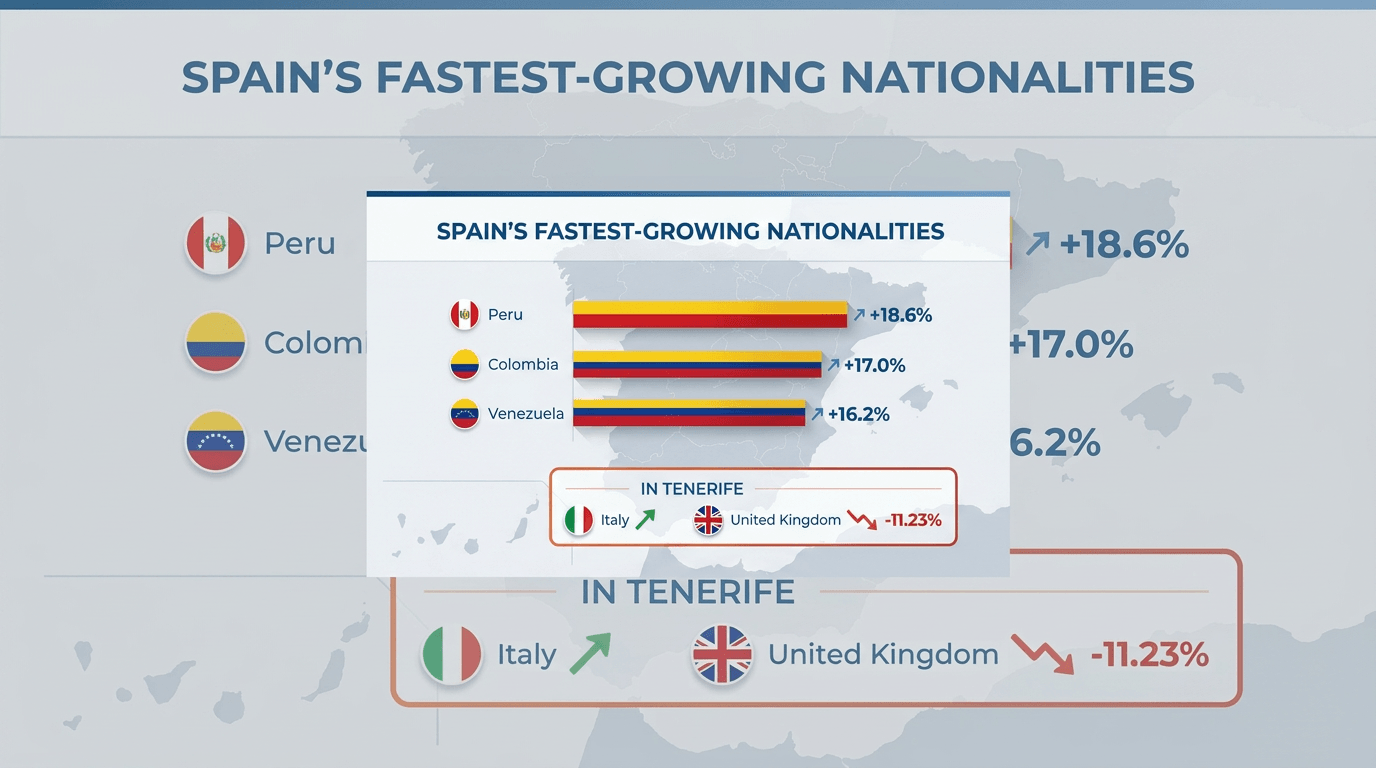
Most people guess British retirees. Some say Moroccans — the longest-established large community. Both guesses miss the mark. Spain's fastest-growing foreign nationalities in 2024–25 are Peruvian, Colombian, and Venezuelan. But zoom in to Tenerife and the Canary Islands, and the headline shifts again: here, Italians hold the top spot while Colombians have nearly doubled their population since 2021 — and the British, once the defining expat community of the islands, are the only major nationality actively shrinking.
To understand how we got here, you have to start at the beginning: the 1950s beach hotels, the charter-flight revolution, and a small island economy that transformed itself into one of the world's great tourism machines.
Part 1: The Tourism Boom That Started Everything (1950s–1980s)
Spain in 1950 was a country in isolation — politically frozen under Franco, economically autarkic, and largely unknown to the sun-seeking middle classes of Northern Europe. That changed almost overnight when the Plan de Estabilización of 1959 liberalised the economy, devalued the peseta, and invited foreign capital. The timing aligned perfectly with the postwar rise of disposable income in Britain, Germany, and Scandinavia. Within a decade, the "package holiday" had been invented, charter aviation had made the Mediterranean accessible to the working class, and Spain had the infrastructure — beaches, sunshine, cheap prices — to absorb millions of visitors.
The Canary Islands followed a slightly later trajectory. The first German package flight to the islands is recorded as early as 1956; British tour operators began organised packages around 1963. The islands' trump card was year-round warmth — the volcanic archipelago off the West African coast never freezes, making it the only destination in Europe that can guarantee beach weather in January. By 1965, the islands were receiving 316,500 tourists. By 1970, that figure had hit 821,000.
Tenerife South Airport (Reina Sofía), which opened in 1978, was the pivotal moment for the island's south coast. The airport effectively unlocked the desert scrubland around Playa de las Américas and Los Cristianos for mass development. The resort of Playa de las Américas was, quite literally, built from scratch on bare rock during the 1970s. By 1979, Tenerife's annual visitor count had passed 2 million.
Chart 1 — Canary Islands: Annual Tourist Arrivals, 1960–2025
From 69,000 visitors to 18.4 million in 65 years
Sources: Wikipedia (ISTAC/FRONTUR data compilation); turistas-canarias.com (ISTAC)
The numbers above speak for themselves, but they also tell a story about who those tourists were. Throughout the 1970s and 1980s, the Canary Islands' visitors were overwhelmingly British and German. By 2006, the British alone accounted for more than a third of all tourists arriving in Tenerife; Germans made up about 13%. These nationalities didn't just visit — many of them stayed, retiring to the year-round warmth and lower cost of living. The "tourist-to-resident" pipeline that defines the islands' expat communities today was laid in this era.
Historical Milestone
Tenerife's worst moment — the 1977 Tenerife Airport Disaster, the deadliest accident in aviation history (583 deaths, involving two Boeing 747s at Los Rodeos Airport) — caused only a brief dip in tourist arrivals. The sector recovered quickly, underlining how structurally embedded tourism had become in the island's economy by that point.
Part 2: Spain Was an Emigration Country First
It is easy to forget, looking at Spain's 14.1% foreign-national share today, that for most of the 20th century Spain was a country of emigrants. Between 1950 and 1970, approximately two million Spanish workers left for Germany, France, Switzerland, and the Americas. The country's foreign-national population in 1981 was just 198,042 — barely half a percent of the total. Spain officially became a net receiver of immigrants only in 1991.
Chart 2 — Spain: Foreign Nationals as % of Total Population, 1981–2025
From 0.52% to 14.1% in four decades
Sources: Wikipedia (INE data compilation); INE – Annual Population Census 2025
Chart 3 — Spain: Foreign Nationals (Absolute Numbers), 1981–2025
Census and Padrón benchmark years only (1981, 1991, 2001, 2024, 2025) — intermediate years omitted to show verified INE figures only
Sources: Wikipedia (INE data compilation); INE – Annual Population Census 2025
| Year | Foreign nationals | % of population | Key context |
|---|---|---|---|
| 1981 | 198,042 | 0.52% | First reliable census count; Spain still a net emigrant country |
| 1991 | 360,655 | 0.91% | Spain becomes net immigration receiver; EU membership since 1986 |
| 2001 | 1,370,657 | 3.33% | Construction boom begins; first large Latin American wave |
| 2024 | 6,502,282 | 13.8% | Latin American surge; Colombia adds 98,057 in one year |
| 2025 | 6,911,971 | 14.1% | Record high; fastest-growing: Peru (+18.6%), Colombia (+17.0%), Venezuela (+16.2%) |
Sources: INE – Annual Population Census; Wikipedia compilation of INE/UN data
Part 3: Spain 2024–25 — Who's Growing and Who's Shrinking
Spain's most recent annual data (1 January 2025) shows 6.9 million foreign nationals living in the country — a 6.3% jump in a single year. The story within that headline figure is where it gets interesting.
Chart 4 — Spain: Fastest-Growing Nationalities 2023–2024 (% Change)
Year-on-year percentage change in registered foreign nationals
Chart 5 — Spain: Largest Absolute Change in Foreign Population, 2023–2024
Net change in number of registered residents by nationality (one year)
Why are Latin American nationalities surging?
Three converging forces explain the acceleration. First, political and economic instability — Venezuela's humanitarian crisis, Colombian internal displacement, and economic pressure in Peru — has pushed outward migration for over a decade, and Spain's language, legal framework, and historical ties make it the destination of choice. Second, Spain's post-pandemic labour shortage in hospitality, construction, logistics, and domestic care created immediate demand. Third, Spain's regularisation pathways (including arraigo programmes linking residency to documented employment) mean that arrivals who were initially undocumented can and do regularise over time, appearing in the INE padron figures.
Why is the British population declining?
Brexit is the single clearest explanatory factor. Since January 2021, British citizens no longer benefit from EU freedom of movement: they must apply for residency, meet income thresholds, and navigate Spanish bureaucracy in a way they never previously had to. Newer British retirees choosing to relocate face significantly higher administrative barriers than the generation that settled under EU rules. Meanwhile, the existing British community in Spain — and especially in the Canary Islands — is demographically ageing, with a growing proportion in the 65+ cohort, and insufficient younger arrivals to offset natural attrition.
Part 4: The Canary Islands — Where the Story Changes
The national headlines about Peruvians and Colombians driving growth are accurate — but they miss a regional dimension that makes the Canary Islands story genuinely distinct.
The Canary Islands' foreign resident population has grown 343% since the early 2000s, rising from 77,196 to 342,612 residents as of 2026, according to data compiled by the Instituto Canario de Estadística (ISTAC). That growth has not been uniform across nationalities — and the nationality leading the growth is one that barely registers in the national headlines.
Between 2021 and 2025, Italians remained the single largest foreign nationality in the Canary Islands (55,553 residents), while Colombians nearly doubled their population (+98.56%), and the British suffered an 11.23% decline — the only major nationality going backwards. Source: DA News (ISTAC data), August 2026
Chart 6 — Canary Islands: Top Foreign Nationalities, 2021 vs 2025 (Number of Residents)
The shift from a British-dominated expatriate community to a Latin American and Italian one
Source: DA News (ISTAC data)
Chart 7 — Canary Islands: % Change in Foreign Residents by Nationality, 2021–2025
Colombia and Venezuela surging; the UK the only major group in decline
Source: DA News (ISTAC data)
| Nationality | 2021 | 2025 | % Change | Notes |
|---|---|---|---|---|
| Italy | 50,383 | 55,553 | +10.26% | Largest foreign community in the archipelago |
| Colombia | 16,308 | 32,381 | +98.56% | Fastest percentage growth of any major nationality |
| Venezuela | ~20,140 | 28,200 | ~+40% | Third-largest community |
| Germany | ~25,120 | 27,631 | ~+10% | Stable growth; older demographic |
| United Kingdom | 28,995 | 25,740 | −11.23% | Fell from 2nd to 5th place; Brexit impact; ageing community |
| Morocco | ~18,200 | 20,382 | — | Steadily growing; working-age |
Source: DA News (ISTAC data), August 2026. 2021 figures for Germany, Venezuela and Morocco are back-calculated from reported percentage changes and should be treated as approximate; Morocco's growth rate was not reported.
Part 5: The Age Divide That Explains Everything
Understanding why the British and German communities are declining relative to Latin American and Italian groups requires looking at demographics — specifically, age profiles. And the contrast is stark.
Chart 8 — Canary Islands: Age Profile of Foreign Residents by Nationality
% of community aged 65 or over vs. working-age (under 65)
Source: DA News (ISTAC data)
The numbers tell a precise generational story. Among British residents in the Canaries, almost 40% are aged 65 or over. For Germans, the figure is around 32%. These communities represent the first wave of residency migration — the generation that arrived in the 1970s, 1980s, and 1990s, drawn by sun, low costs, and EU freedom of movement. They are ageing in place.
The Italian community, by contrast, has just 15% aged 65+. And among Colombians, it is a remarkable 4.3% — meaning 95.7% of Colombian residents in the Canary Islands are under 65. This is a working-age migration, driven primarily by employment in hospitality, construction, and domestic care rather than retirement.
The implication is structural, not cyclical. The British community isn't just shrinking because Brexit made residency harder — it is biologically declining, with an older cohort not being replenished by younger arrivals. Italian and Latin American communities, by contrast, have demographics that skew toward growth: younger residents who will stay, work, form families, and eventually apply for Spanish nationality.
Part 6: Tenerife — Numbers That Reframe the Debate
Tenerife is the archipelago's largest island and hosts roughly half of its total foreign population. The island's demographic shift is the most advanced and the most visible:
The municipalities where foreigners outnumber locals
Three Tenerife municipalities have crossed a threshold that would have seemed extraordinary even a decade ago: their foreign-born population now exceeds the locally-born population:
| Municipality | Foreign-born % | Character |
|---|---|---|
| Adeje | 56.52% | South Tenerife's premium resort hub (Costa Adeje) |
| Arona | 51.8% | Playa de las Américas, Los Cristianos — heart of package-holiday Tenerife |
| Santiago del Teide | 51.5% | Rural west coast; smaller scale but equal magnitude of shift |
Source: Tenerife Weekly (ISTAC data), August 2026
Note that Tenerife, despite these striking absolute figures, actually ranks behind other Canary Islands in relative terms: Fuerteventura (38.4% foreign-born), Lanzarote (33.2%), El Hierro (30.5%), and La Gomera (25.4%) all show higher ratios when the whole island population is considered.
The British retreat from the south
The decline of the British community in Tenerife is not abstract — it has a precise geography. The municipalities where British residents are falling fastest are exactly the ones they historically dominated most:
- Adeje: −578 British residents, 2021–2025
- Arona: −445 British residents, 2021–2025
- San Miguel de Abona: −307 British residents, 2021–2025
The communities being built in these same resorts today look very different — younger, more Italian and Latin American, more employed in the hospitality sector rather than retired from it.
Migration moving inland
One of the more underreported trends in Tenerife's demographic evolution is that foreign settlement is no longer confined to coastal tourist centres. Interior and agricultural municipalities — places that rarely appeared in the expat property press — have seen dramatic foreign resident growth between 2021 and 2025:
Chart 9 — Canary Islands (Tenerife & Gran Canaria): Foreign Resident Growth in Non-Tourist Municipalities, 2021–2025
The demographic shift has moved well beyond the coastal resort belt
Source: DA News (ISTAC data)
This inland spread suggests the islands' demographic transformation has entered a new phase — less about retirement migration and sun-seeking, more about workers putting down roots in affordable residential areas away from tourist price inflation.
Part 7: What This All Means
The arc from the 1960s package-holiday revolution to today's Italian-Colombian demographics in the Canary Islands is a coherent story, not a series of disconnected facts.
Phase One (1960s–1990s): Tourism creates the residency pipeline. The charter-flight era makes Tenerife and the Canaries accessible to Northern European working-class tourists. A subset of those tourists — especially from Britain and Germany — transitions to part-year and full-year residency. Spain's EU membership from 1986 removes every legal barrier for those residents.
Phase Two (2000–2015): Latin America finds Spain. Spain's construction boom creates labour demand. The 2008 crisis then eliminates many Eastern European workers, but the structural demand in hospitality, care, and domestic services remains. Latin American migrants — initially Ecuadorian, then Moroccan, then increasingly Colombian and Venezuelan — fill the gap. The Canary Islands begin attracting Italian residents in numbers, attracted by language accessibility, climate, and growing Italian-run hospitality businesses.
Phase Three (2021–present): The Brexit reshaping and the Latin boom. Brexit fundamentally alters the British community's growth trajectory. Post-pandemic tourism reaches record highs in the Canaries, creating a hospitality labour vacuum filled by Colombians, Venezuelans, and Italians. The British community ages in place while newer communities grow around it.
Between 2021 and 2025, the Canary Islands' total population grew by 79,942 people. Foreign nationals accounted for 67% of that entire increase — rising from 13.26% to 15.17% of the archipelago's total population. Source: DA News (ISTAC data)
Spain's immigration story, once dominated by Moroccan workers and British retirees, has been rewritten in real time. The country that exported millions of workers to Germany in the 1960s now has a foreign-national share of roughly one in seven residents. And within Spain, Tenerife — an island that barely existed on the global tourist map before 1960 — has become one of Europe's most demographically complex territories, with a foreign-born population that in some municipalities now constitutes the majority.
The next decade's headline, if current trends hold, will not be about whether the British community can recover. It will be about whether working-age Italian and Latin American communities — young, employed, increasingly settled — begin applying for Spanish citizenship at scale, and what that means for an island that built its entire modern identity around serving Northern European tourists.
Primary & Official Sources
- INE (Instituto Nacional de Estadística) — Annual Population Census, First Results 2025 (January 1, 2025): ine.es/dyngs/Prensa/en/CensoVariables2025.htm
- INE — Annual Population Census, 1 January 2024: ine.es/dyngs/Prensa/en/CENSO2024.htm
- INE — Continuous Population Statistics (CPS), April 2025: ine.es/dyngs/Prensa/en/ECP1T25.htm
- INE — Population & Housing Census 2001 – Historical Background: ine.es/en/censo2001/historia_en.htm
- ISTAC (Instituto Canario de Estadística) — Official statistics portal for the Canary Islands: gobiernodecanarias.org/istac/
- UN Tourism (UNWTO) — 50 Years of Tourism (1975–2025) historical overview: untourism.int/50-years-of-tourism-1975-2025
- World Bank — International Tourism, Number of Arrivals (Spain): data.worldbank.org/indicator/ST.INT.ARVL
- Wikipedia — Immigration to Spain (aggregates INE census data, 1981–2025): en.wikipedia.org/wiki/Immigration_to_Spain
- Wikipedia — Tourism in the Canary Islands (aggregates ISTAC/FRONTUR arrival data, 1960–2025): en.wikipedia.org/wiki/Tourism_in_the_Canary_Islands
- DA News — "The foreign population of the Canary Islands has quadrupled over the last 25 years" (cites ISTAC data directly): danews.eu/2026/08/30/…
- Tenerife Weekly — "Foreign-born residents outnumber locals in three Tenerife municipalities" (cites INE/ISTAC padrón data): tenerifeweekly.com
- Bank of Spain (Banco de España) — Working Paper 1503: Historical analysis of Spanish emigration and immigration flows: bde.es/…/dt1503e.pdf
⚠ Data Transparency Note
All statistical figures in this article are sourced from official or officially-compiled data (INE, ISTAC, UNWTO, World Bank). Where figures come from secondary aggregators (DA News, Tenerife Weekly, Wikipedia), those publications explicitly cite the primary official source. One caveat: the pre-1996 historical foreign-resident figures (1981, 1991 censuses) predate the INE's current digital registry system and are drawn from periodic census publications rather than continuous administrative records. They should be treated as indicative benchmarks rather than precise year-round counts.


