



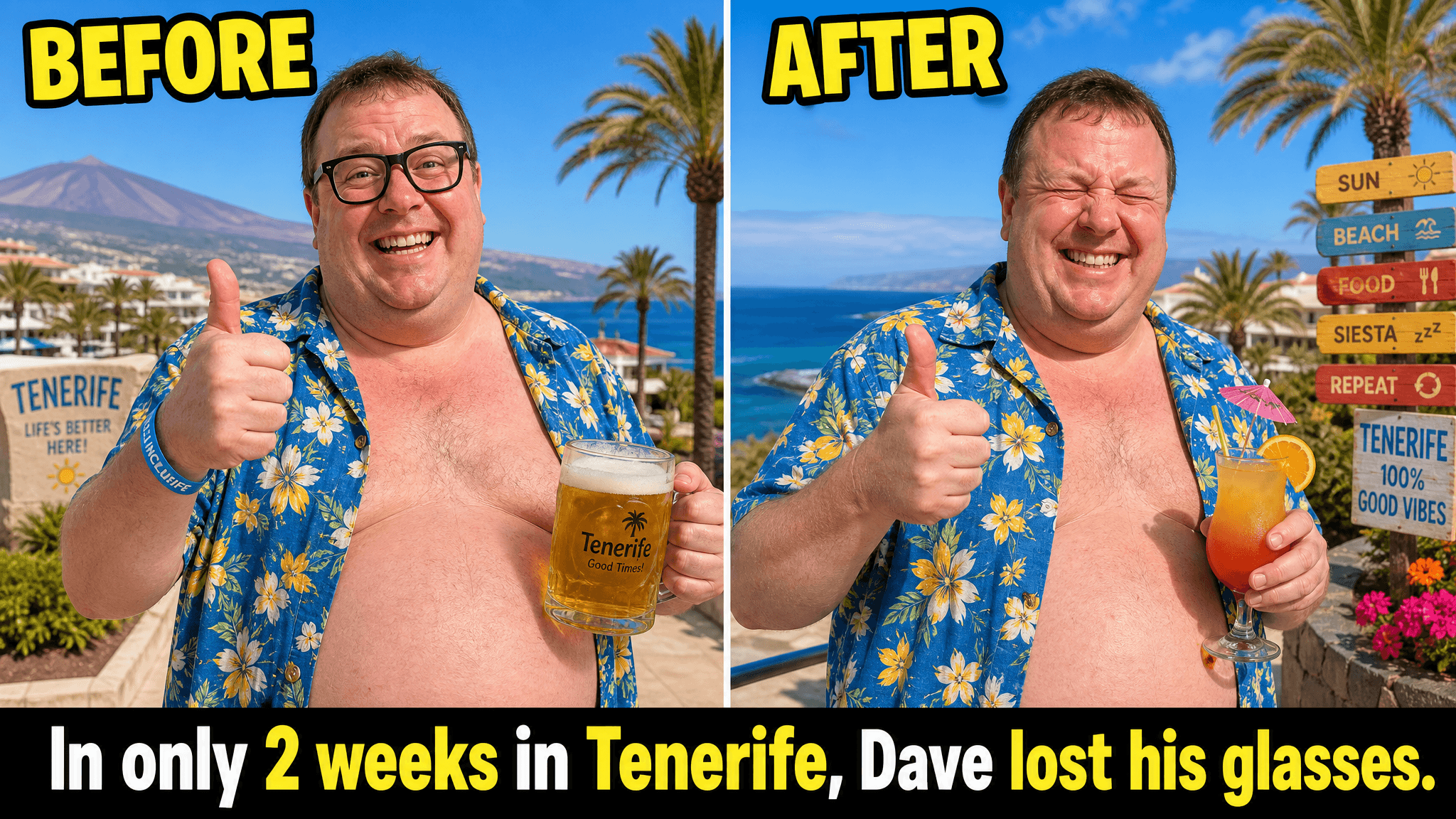
You came home with a great tan, some decent photos, and roughly four extra pounds you definitely didn’t pack. The scales don’t lie, even when you really wish they would.
Gaining weight in Tenerife is so common it’s almost a rite of passage, and yet nobody really talks about it before you go. You get warned about the sun. You get warned about dodgy tap water. Nobody sits you down and says “listen, the food situation over there is going to test you in ways you are not prepared for.” So here it is, from people who found out the hard way.
Why Tenerife Specifically Gets You
It’s not just that you’re on holiday and eating more. Lots of places don’t do this to people. Tenerife has a specific set of conditions that combine into something genuinely difficult to resist, and if you go without knowing what you’re walking into, a week will pass before you’ve had a single conversation with yourself about any of it.
The food is cheap. Really cheap, by British standards. A three course meal with wine on the strip in Los Cristianos costs what a sad desk lunch costs in most UK cities. When everything is that affordable, the psychological brake that normally stops you ordering a starter and a dessert just isn’t there. Why wouldn’t you? It’s basically free.
Then there’s the heat, which does something strange to your appetite and your decision making at the same time. You don’t feel hungry in the usual way, so you stop tracking what you’re eating. You feel thirsty instead, which in Tenerife means cold beer, frozen cocktails, or Coke, not water. You can consume an absolutely extraordinary number of calories just through drinks alone and feel like you’ve barely touched anything.
And then there’s the pace of it. You’re relaxed. You’re not rushing. Meals stretch out. You order another round because nobody’s got anywhere to be. That second basket of bread arrives and you eat it because it’s there and it’s warm and you’re talking and not really thinking about it.
The Holiday Brain Problem
Rachel, 34, from Leeds, described it perfectly: “My normal self would never eat a full cooked breakfast and then a burger four hours later. But holiday me thought that was completely fine every single day for nine days. I don’t know who she is but she needs to be stopped.”
This is the thing. You become a slightly different person on holiday, and that person has a very different relationship with food. Holiday brain is real, it’s not entirely a bad thing, it’s part of what makes a break feel like a break, but it does tend to treat every meal as a small celebration and every snack as a reward for the heroic effort of lying by a pool.
Tom, 41, from Bristol, told me he walked forty minutes each way to a restaurant one evening specifically because he’d read it was good. The food was excellent. He ate about twice what he’d normally eat because he felt he’d earned it through the walk. “The walk was basically cancelled out before I’d finished the bread,” he said. “Possibly before I’d sat down.”
The Portion Situation
The restaurants on the tourist strips are not serving modest plates. They’re feeding people who’ve been out in the sun all day and want a proper meal, and the portions reflect that regardless of whether you’ve actually done anything physical or not.
You also tend to eat later than usual, because that’s the rhythm of the place and it feels right when you’re there. So you have a bigger lunch than normal, graze through the afternoon because there’s a snack place every twelve metres along the seafront, and then sit down to a full dinner at nine in the evening because that’s what everyone’s doing. The timeline of eating basically extends to fill the entire day.
Jess, 27, from Edinburgh, said: “I had churros three times in one day once. Not because I planned to. Just because I kept walking past places selling them and they smelled incredible each time. That’s the kind of person Tenerife turned me into.”
And honestly, that’s not a character flaw. The churros in Tenerife genuinely do smell incredible. That’s a real and legitimate problem.
The Drinking Maths Nobody Does
This is the part people most consistently underestimate. The drinking.
It’s warm, so you drink more. The evenings are long, so you drink across a longer stretch of time. The cocktails are cheaper and often enormous, served in glasses that appear to have been designed for a different species entirely. A couple of drinks with dinner at home becomes drinks before dinner, wine with dinner, and something cold on the walk back, every night, for a week or ten days.
Alcohol calories are invisible in the way food calories aren’t. You can see a plate of chips. You can’t really see what’s in a frozen margarita, and your brain doesn’t file it under “eating” anyway.
Mark, 55, from Newcastle, did the rough maths on his flight home and genuinely couldn’t finish the calculation. “I gave up around Wednesday,” he told me. “It was too depressing and I still had four days left.”
The Walking Doesn’t Save You (Sorry)
The most common thing people say when they’re trying to reassure themselves mid-trip is that they’re walking loads. And they are, in fairness. The seafront promenades in the southern resorts are long and flat and genuinely pleasant to walk along in the evening. People do cover some distance.
But a forty-minute flat seafront stroll burns maybe two hundred and fifty calories. A generous plate of patatas bravas, a main course, two beers and a dessert is somewhere in the region of two thousand. The numbers are not on your side and the walk knows it.
The hikes up around Teide or through the Anaga Rural Park in the north are a completely different matter. Those are proper, your-legs-know-about-it-tomorrow walks, and they’re worth doing for about fifteen reasons beyond the calorie point. But even then, the tendency is to celebrate a hard morning’s hiking with a large lunch, because you’ve earned it, which, yes, but also, the maths again.
What People Who Came Back Feeling Fine Actually Did
I didn’t want this to just be a list of ways Tenerife will quietly expand you, so I asked people who’d had a good trip and come back without the bathroom scale reckoning what they’d done differently.
The consistent answer was not that they’d been disciplined or restrained or done anything that sounded like hard work. It was more that they’d been slightly more deliberate about it. They ate big when they wanted to eat big and they didn’t when they didn’t. They drank water alongside the other stuff rather than instead of it. They made a point of getting off the strip and into the actual island, partly because the food up in the smaller towns and villages is genuinely better and the portions are less tourist calibrated.
Anna, 45, from Dublin, who’d been to Tenerife five times, said: “I stopped thinking of every meal as a treat by about the third trip. When everything is a treat, nothing is. I pick one or two meals a week where I just eat whatever and enjoy it completely, and the rest of the time I eat like a person.”
That’s a reasonable philosophy for life in general, honestly.
One Thing Worth Knowing Before You Go
The food in the north of the island is different from the food on the southern tourist strip, and not just in terms of quality. The restaurants in places like La Laguna or the villages around the Orotava Valley are smaller, the menus are shorter, and you’ll eat things that are actually local rather than things designed to be broadly acceptable to as many nationalities as possible. The Tenerife Information Centres have decent orientation info if you’re trying to plan beyond the resort, and it’s worth ten minutes of your time before you go.
Fresh fish, local cheese, decent wine from the volcanic soil in the north, which tastes genuinely unlike wine from anywhere else and is worth trying even if you’re not usually a wine person. That’s the food that Tenerife is actually good at, and you can eat that stuff every day without coming home feeling like a cautionary tale.
Last Words
Nobody should go to Tenerife and spend a week being anxious about food. That’s not the point of any of this. The point is that a bit of awareness going in saves you from a slightly grim moment on the scales going out.
Eat the churros. Have the long dinner. Get the cocktail that arrives in a glass the size of a small bucket. Just maybe not all of those things every single day without noticing.
Tenerife is genuinely enjoyable. The weight thing is real, it happens to almost everyone, and knowing it’s coming is more than half the battle. The other half is the churros. Good luck with those.


