


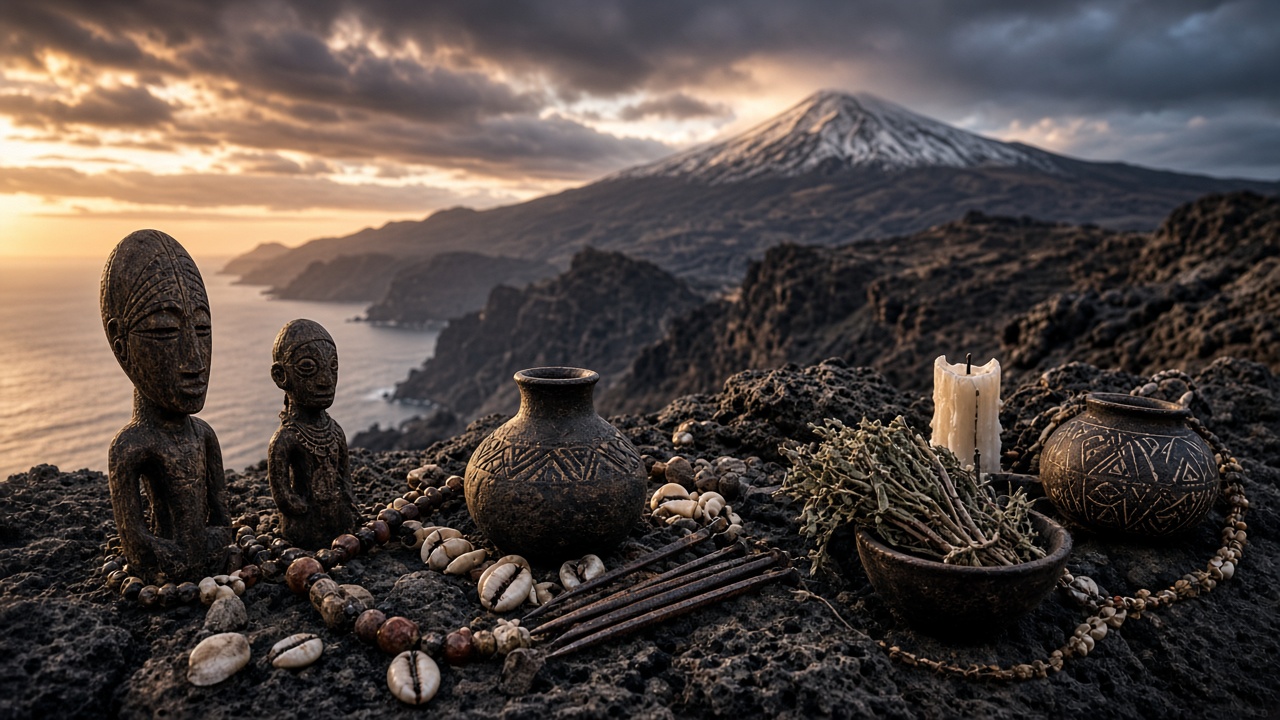
From African amulets and witchcraft to Santería and Latin America
In the 1490s, Tenerife was taken over by the Castile and throughout history, it became a cross Atlantic hub.
How has Tenerife’s location at the meeting point of Africa, Europe and the Americas influenced its migration, the religious and magical practices of its people, and what can still be seen today?
Whilst it’s true that there are links and lots of evidence to back this up, not all links are as strong as some believe. It’s often thought that the Guanche religious tradition continues today in the form of local magic, that African influences are prominent in Canarian popular culture, and that Santería has strong historical connections with Tenerife.
Below is a summary of what has been shown to be accurate through research.
| Claim | How well supported | Main evidence |
|---|---|---|
| The Guanches came from North Africa | Strong | Ancient DNA studies (2017, 2023) |
| Conquest turned many Guanches into captives, followed by Moriscos and sub-Saharan Africans | Strong | Notarial and council records, baptism and burial books |
| Santa Cruz was a transit port for enslaved people, and 18th-century graves there hold sub-Saharan lineages | Strong for the port and the 18th century. Shipments to Cuba or Venezuela are not quantified in the sources found | Burial books, DNA from the Concepción church |
| Enslaved Africans and Canarian women kept healing and protective practices recorded by the Inquisition | Documented, but disputed: historians disagree on how African those practices were. Only one Tenerife-born case is examined here | Inquisition files held in Las Palmas |
| Canarian healing beliefs travelled to Cuba, and Cuban prayers came back | Documented | Ethnographic studies |
| Santería on Tenerife | Documented as a modern, migration-driven presence; no evidence of a historical community | Anthropological fieldwork |
| Marabouts and protective amulets among people on the Atlantic route | Documented for Senegal and The Gambia, not for those who landed on Tenerife. Two court cases allege killings at sea linked to witchcraft accusations | Surveys, court reports |
| Guanche religion surviving in folklore | Weak, beyond place names, some remedies and the Candelaria story | Folklore and Inquisition studies |
How I Researched
I focused particularly on Universidad de La Laguna and Universidad de Las Palmas records, plus the proceedings of the Coloquios de Historia Canario-Americana (Casa de Colón).
Most of the research was in Spanish, and where appropriate, I’ve noted where information stems from student work and/or media. Archives and the Archivo Histórico Diocesano de Tenerife were not used.
Tenerife and Africa – origins of the island’s original inhabitants
Historical records and more recent ancient DNA tests confirm that the original inhabitants of Tenerife were of North African descent.
In 2017, genome-wide data for Guanche people was analysed by Current Biology. Samples were collected from Gran Canaria and Tenerife.
Of 11 samples analysed, 5 dated between the 7 th and 11 th Century CE allowed for detailed analysis. These people were most closely related to modern northwest Africans, strongly implying that the Guanches originated from a Berber-like group of people. A minor element of their genetic make-up was similar to that of European Neolithic farmers. This too is found in differing proportions in other areas of North Africa (Stockholm and Liverpool John Moores researchers, 2017).
Previous research has identified North African Y-chromosome types (E-M81, E-M78 and J-M267) together with mitochondrial type U6b (Liverpool repository reference). More recently, a 2023 genome-wide analysis of the indigenous population of the Canary Islands, published in Nature Communications, established that the majority of indigenous men belonged to a North African Y-chromosome type (E-M183) which existed prior to the islands being colonised. Islanders were likely to have been geographically separated from mainland areas prior to Islamic conquests.
There are a number of caveats to note:
- Although radiocarbon dating of charcoal, plant and animal material suggests the islands were inhabited from around the 5 th Century BCE, there is still uncertainty regarding the number of and identity of those who initially populated them.
- Only Tenerife has been analysed. The frequently-mentioned statistic that 16-31% of the autosomal DNA of modern Gran Canarians is Guanche relates to just two modern Gran Canarian individuals. This should not be assumed to apply to Tenerife.
- DNA indicates origin, not faith. None of the research analysed provides any information regarding the faith of the original Tenerife inhabitants nor whether or not they maintained links with the mainland. As such, this information is not claimed within this article.
Tenerife’s association with Africa dates back to the earliest times in its history. The Spanish conquest of the island drew to a close in 1496. This introduced a second, imposed African association for Tenerife; that of slavery.
Guanche faith – what is known and what is inferred
Whilst funerary rites are most thoroughly recorded, much of the remaining information regarding Guanche faith is provided by non-impartial sources from the conquest period.
What’s the evidence?
Tenerife’s Guanches mummified their dead. Despite differing from the Egyptian method, CT scans of 21 mummies show that these bodies were remarkably well-preserved. Not all members of society were mummified though. Instead, it seems that this was predominantly restricted to the elite, including menceyes (chiefs), nobility and heroic figures.
Individuals who were fully desiccated were known as xaxos. Society was stratified and each territory was headed by a mencey, who was elected at a gathering called a tagoror. The Museo de Naturaleza y Arqueología (MUNA) in Santa Cruz has the greatest number of Guanche mummies in the archipelago.
What has been concluded?
Post-conquest and subsequent re-tellings of Guanche myth include references to deities such as Achamán (god of the skies or supreme deity on Tenerife), Magec (sun) and Guayota (malevolent spirit linked to the Teide volcano).
A 1996 paper analysing the archaeology of Guanche faith in Anuario de Estudios Atlánticos cautions that the sources analysed adopted the term ‘idolatry’ when discussing Guanche faith. They viewed the islanders’ faith as a corrupted form of the ‘true’ faith, and so there is a potential for inaccuracy. The myths should therefore be treated as traditions rather than verbatim accounts.
The African connection
- As previously discussed, there is clear evidence of North African origins, and the Guanche language is currently being analysed by those working at Canarian institutes and compared with modern Tamazight dialects (Diario de Avisos).
- Whilst it’s reasonable to believe that there was some continuity between Guanche faith and that of mainland Amazighs, there is no source within my research that confirms that particular mainland rites were widespread.
Did it survive?
Analysis of Inquisition cases of witchcraft undertaken by ULL has concluded that the impact of indigenous culture on Canarian witchcraft was relatively limited in comparison to that of Portuguese, Castilian and Berber-African cultures.
Although Guanche faith had a significant impact on both landscape and myth (particularly Teide), there is limited evidence of active Guanche faith continuing in the 16 th century or later.
Tenerife’s slavery history – from Guanche slaves to a re-export slave port
Tenerife was involved in slavery in several phases. It functioned both as a site of slave labour and as a transhipment point for slaves destined for other locations.
| Period | Who was enslaved | What the Tenerife records show |
|---|---|---|
| 1490s to about 1525 | Guanche captives, including people from kingdoms that had made peace | Castilian troops landed at Añazo (today’s Santa Cruz) on 3 May 1494. Manuela Marrero’s research, summarised in a 2016 ULL historiography review, shows that a pact protecting four allied kingdoms (Anaga, Abona, Adeje, Güímar) was not respected, with mass sales of Guanches between 1492 and 1496. The Cabildo ruled in 1500 that captives be freed after 16 years; Marrero found this often ignored. |
| About 1510 to the 1560s | Moriscos and other captives from the Berber coast | The Canarian Morisco minority arose from raids on the North African coast to ease labour shortages on sugar estates, vineyards and herds, according to Emilio Alfaro Hardisson. |
| 16th to 18th centuries | Black Africans, supplied through Portuguese trading posts in Cabo Verde and Guinea, later Angola | Calderón Ordóñez and colleagues trace the supply routes; the evidence on Tenerife is in parish books and in DNA from 18th-century graves (below). |
Individuals Mentioned. The 1541 document in which Tenerife council attempted to deport free Moriscos is in La Laguna’s archive, and from there we can trace certain individuals.
Luis de Aday arrived on the island between 1523-6 and gained his freedom for working as a guide and interpreter (adalid) on expeditions. He then paid 80 gold doblas for the emancipation of his Morisca wife, María de Lugo, and was then captured before managing to flee to the Portuguese fortress of Arguim.
Free Moriscos were to leave Tenerife within 30 days (as ordered by the lieutenant governor) – guides were granted an exemption and the rest were given an extra month (Alfaro Hardisson).
Numbers and locations. Analysis of La Laguna baptism registers indicates that Black Africans formed 75.5% of the slaves baptised in the second half of the 16th century, progressively supplanting Guanches.
Around 15% of La Laguna’s population were slaves compared to around 12% in Gran Canaria (a historian cited in Diario de Avisos). Santa Cruz had an even smaller percentage: 4.14% of baptisms in the Concepción church between 1635-50, and around 3.3% of the 18th century population (Alejandro Cioranescu’s estimate).
Santa Cruz as an emporium. As soon as the conquest had been completed, Santa Cruz became a centre for the slave trade. Initially slaves were brought in for sugar production and later for domestic use. Many individuals were transient and were rapidly re-exported to America.
The Concepción church register of burials includes 188 slaves (out of 1056 total), including one male who had travelled to the island on Juan de la Fuente’s slave vessel (1674), and a female from Juan Díaz Falcón’s caravel (1687) slave hold.
DNA data further supports this. Human remains from 1993 and 1995 excavations numbered at least 776. Sub-Saharan maternal DNA accounted for 15.6% of this, a much higher proportion than is now found amongst Canarians.
Certain sub-Saharan DNA types are only present in African Americans, the Azores and São Tomé. Burial register information (1767-80) shows slaves originating from Senegal (4), Angola (3), Cabo Verde and Guinea. Some African DNA was already part of Guanche DNA and so not all African DNA necessarily relates to slavery.
Moving between islands. Manuel Lobo Cabrera’s research (summarised in the review of work undertaken by the University of La Laguna) indicates that slaves were transported through the Canary Islands to Cartagena de Indias and New Spain. Permits for this were issued from 1518. Claudia Stella Geremia describes the Canary Islands and Macaronesia as a ‘laboratory’ for America’s later slave economy (elDiario.es).
Post-1488 revolt, around 300 Gomerans were freed and settled in Tenerife as freed men. There is no source specific to Tenerife which provides statistics regarding the number of slaves transported from here to Cuba and Venezuela. Although American export routes are known, those specifically to these two countries are not.
A later reflection. Nelson Díaz Frías’ 2021 book discusses Rosalía Gómez (1801-74) who was born in the island’s south to a slave mother and may have been Tenerife’s last slave. She died in Arona. There is variation in accounts of who she was and so this must be approached with sensitivity.
Church, Inquisition and African spirituality
Church and Inquisition records reveal that people of African descent in the Canary Islands practised forms of healing and protection which were difficult to categorise within Catholic doctrine. Views differ as to how ‘African’ these practices were.
Inquisition. The first inquisitor, Tribaldos, arrived in 1505 and commenced hearings in 1507. A permanent inquisition was established in Las Palmas in 1524. Previously, an ecclesiastical delegate had issued a ‘grace edict’ in La Laguna and Las Palmas in 1499 (ULL dissertation, Samuel González Montesinos).
Consequently, Tenerife does not appear as a centre but rather as a place of denunciations. Full inquisition records are housed in Las Palmas’ El Museo Canario. Geremia states that this is unusual for the Spanish monarchy.
The scale. Of those tried for witchcraft, 368 people were prosecuted (327 females) and approximately half belonged to minority groups. Witchcraft was classed as a relatively trivial offence. No-one from the Canary Islands was ever extradited for trial and execution for this.
The most active period of witchcraft prosecution was 1660-40 (punishments included flogging, shaming and banishment). Later prosecutions typically resulted in a reprimand. Around 300 females were prosecuted between 1505 and 1819 (Geremia, conference paper, 2020).
The disagreement. Whilst Fajardo Spínola believed that Berber influences were present in Canary Island witchcraft and cited examples such as palm-camel dung, fire, saffron and henna powder and string divination, he considered that this was later blended with European witchcraft.
Another historian, Sánchez Ortega, did not detect any evidence of North or sub-Saharan African magical practices in Canary Islands traditions and considered that these were distinctly Iberian. Limited indigenous influence is also apparent, with just six denunciations.
Geremia (article, 2024) holds the opposing view and contends that northern and western African influences are distinct within Canary Islands culture.
What Geremia uncovered.She describes bolsas mandinga – pouches containing images of saints, together with prayers and stones – used for protection and to attract a partner on San Juan night. Defendants claimed to conceal these and had learnt to sew them from their mother or grandmother. She considers that these originate from West Africa. They have been researched in Brazil, Cartagena de Indias and Cuba but not in the Canary Islands (elDiario.es). Interestingly, the items held within them are Catholic.
Other artefacts mentioned in inquisition records, such as piedra de ara (altar stones) and cartas de tocar (paper talismans), are also commonly found in Portugal and Spain. Again, this demonstrates amalgamation but does not definitively establish origin.
Tenerife specific example. María Felipa, a Tenerife-born slave of African parentage, was a healer. She was prosecuted in 1714-18 in a tri-island case (Tenerife, El Hierro and La Palma). Geremia states that she was imprisoned in Puerto de la Orotava and then exiled. She subsequently escaped and was assisted in returning to Tenerife from La Palma in 1715 by four people (a hospital priest, a sacristan, a doctor and a captain) who were fined 10 ducados. As evidence, a small paper talisman was confiscated. It was possible to attain freedom if one absconded and remained away for a year and a day (according to contemporary law).
Church artefacts for protection. Whilst official and popular culture often coincided, on La Gomera mini-evangelios were produced in convents to ward off the evil eye. Juan Bethencourt Alfonso’s 1901 survey also mentions red ribbons, horns and heart-shaped higas (filled with garlic and pepper) as protective items. Slaves were baptised and their names entered in parish registers. Throughout the Canary Islands the Church never officially opposed slavery although it did criticise inhumane masters (Mateo López; ULL historiography review).
Did Tenerife create its own mix? Two areas clearly demonstrate Tenerife’s synthesis of cultures – the Candelaria devotion (Guanche and Catholic, below) and protective artefacts that incorporate both African and Catholic elements. It is reasonable to consider that a triad of Guanche, African and European cultures existed. The contribution of each culture remains hotly debated, and the inquisition records are unable to resolve this issue.
Tenerife, Cuba and Venezuela: Atlantic emigration
Of Tenerife’s connections to America, emigration to Cuba and Venezuela is most well recorded. Historians from the Universidad de La Laguna have provided in-depth analysis of this.
The routes. Canarians travelled to America from soon after Columbus’ time. Manuel Hernández González’s Canarian emigration survey highlights that 1569 saw the migration of sugar mill experts to Hispaniola. During the 18th and early 19th centuries Tenerife thrived due to Atlantic commerce and emigration. Consequently, Tenerife was more adversely affected by Venezuela’s independence wars than Gran Canaria.
Predominantly, Tenerife families emigrated to Venezuela during the 19th century. Cuba, however, received the greatest number of emigrants from the Canary Islands as a whole. Of a total of 23,623 19th century emigrants, 19,627 (83%) went to Cuba. Locally, between 1850-77 the vast majority of San Juan de la Rambla emigrants went to Cuba. Venezuela is only mentioned in 1874 and 1876.
Beliefs exported. María del Carmen Mateo López’s research on Canarian ethnomedicine in Cuba illustrates that between 1880 and 1930 Canarians took their healing and evil eye beliefs with them. These were largely disseminated via family emigration and intermarriage within the community, and women were usually the ones who spread these belief. Cuban respondents many years later described the medical treatments used as ‘islanders’ things’. For example, a prayer was recited for throat ailments which invoked the Virgen de la Candelaria.
Lydia Cabrera is quoted as stating that Canarians introduced the practise of the garlic string into Cuban Santería. Mateo López hypothesises that Canarians used their evil eye beliefs to distinguish themselves from neighbouring Afro-Cubans. Black Cuban healers viewed Canarian female healers as competitors.
Beliefs imported. Printed prayer sheets were exported from Cuba to Tenerife. One dating from Havana in 1836 has been located in Tenerife. A prayer to San Luis Beltrán against the evil eye was brought to Tenerife from Fomento in Cuba’s Las Villas province. Mateo López interprets this as an illustration of Canarian culture’s continuity in the Caribbean rather than Cuban influence on Canary Islands beliefs.
Most recent emigrant-derived Canarian folk medicine components include the Havana printed prayer to San Luis Beltrán and statuettes of the Venezuelan doctor-saint José Gregorio Hernández (displayed in bars, cemeteries and homes) (folklorists Manuel Lorenzo Perera and María Dolores García Martín). Some card readers also learnt their craft abroad in Argentina and Cuba (ULPGC digital library).
Transporting Candelaria. The Virgin of Candelaria, Tenerife’s patron saint, was also taken by Canarians to Cuba, Veracruz, Texas and Louisiana. Abel Juárez Martínez claims that in Cuba and Mexico, Candelaria devotion was combined with local water and oceanic cults, including the Afro-Cuban deity Oyá (XXIV Coloquio de Historia Canario-Americana). Please recognise that this is one scholar’s theory.
Reverse flow. Today, Tenerife has the largest Venezuelan community (30,783) of any island, together with 7,920 Cubans. A 2023 report indicated that there were in excess of 52,000 Venezuelans living in Tenerife, equating to around 5% of the island’s population.
Many of these are dual nationals and have returned to Tenerife. Overall across the Canary Islands, there are 63,837 Cubans resident (ISTAC data, January 2025).
Santería and other African derived faiths: Tenerife evidence
Santería (also known as Regla de Ocha or Osha) is a Cuban religion. It matches Yoruba gods (orishas) with Catholic saints. Changó is associated with Santa Bárbara, Yemayá with the Virgen de Regla, and Oshún with the Virgen de la Caridad del Cobre (Pérez Amores).
This is part of a wider family of Afro-Cuban faiths which also includes Ifá divination, Palo Monte, Regla Arará and Abakuá (García Viña). Below are the links between these practices and Tenerife as identified in the reviewed literature:
| Tradition | Origin | Link to Tenerife in the sources |
|---|---|---|
| Santería (Osha) | Cuba, Yoruba-derived with Catholic saints | Documented today: initiated practitioners, home consultations, esoteric shops |
| Palo Monte | Cuba, Congo-derived | Present but low-profile: paleros exist, mostly working privately; locals often confuse it with witchcraft or “voodoo” |
| Vodou | Haiti | Not documented: no study of a Tenerife community found; a ULL teaching slide lists a “bruja vudú” among practitioner types in the Canaries |
| Candomblé | Brazil | Nothing found for Tenerife in these sources |
| Traditional West African religion and Islamic amulets | West Africa | Documented in two periods: enslaved Africans (Inquisition files, above) and modern migrants (next section) |
Dual influences. Main influences are the Cuban and Venezuelan emigrant communities. With Cuba legalising the dollar in 1994, immigration then became more common for marriage and/or work. Venezuelans often practice Santería and the cult to María Lionza.
Canarians who have returned, or whose families have returned from Cuba and Venezuela, are influenced. The Canarian community’s natural remedies and religious culture were strongly influenced by Afro-Cuban religions. Some claim to have been introduced to these cults as children in the emigrant community.
What’s it like? Healing and/or spiritism can occur in people’s homes and also in specialist shops. Clients may also wear white and beaded collares and bracelets. Pérez Amores discusses a Tenerife based santera and spiritist whose shrine displays saints from Portugal, Venezuela, Cuba and Galicia.
Much of her knowledge was gained from a curandera in Venezuela. Another Cuban born spiritist covered her Elegguá doll in clothes and even checked-in with airport authorities. Whilst most healers are Catholic, there is not actually any opposition to spiritism on Tenerife, but Pérez Amores observed a degree of discretion.
Some avoid discussing their shrine with friends due to the joking which may occur about “Third World Cuban things”. A 2012 article highlighted the Barranco de El Cercado in San Andrés as popular for carrying out santero rituals but more recently in Santa Ursula.
Evidence constraints. Just because something is currently present does not necessarily mean that it was in the past. I could not identify any source to show that Santería was practised on Tenerife prior to the late 20th century. Historically, the Canarian healing culture was influenced by Afro-Cuban religion in Cuba. As previously mentioned, the devotion to Candelaria is also reflected in Cuban and Mexican beliefs.
Marabouts, jujus and the modern transatlantic route
In 2024, a record 46,843 people reached the Canaries from West Africa (Yahoo News). This rose to nearly 17,000 in 2025 (PBS NewsHour). People travelled across around 1,000 nautical miles. Around 10,000 people are thought to have died in 2024 attempting this journey (Caminando Fronteras, an aid organisation, estimates) (The Maritime Executive).
As I could not find any research into the specific beliefs and items carried by people migrating to Tenerife, evidence was gathered from migrants’ countries of origin and court records. Please note that this is not representative of all migrants.
Belief in protective powers. A survey of 10,181 young people in Greater Banjul, Gambia, discovered that around 30% had consulted a local healer (sheikh or traditional healer) for protection. Furthermore, 14% had also worn jujus (also known as gri-gri) for protection. Those who had recently undergone healing for protection were 5-10 percentage points more likely to try to migrate.
If someone had both consulted a healer and worn a juju, they believed they had a c.58% chance of successfully migrating, compared to an average 50%. Previous research has shown that marabouts are believed to provide protective powers.
They are also thought to determine when people leave and to review passenger lists for ‘difficult’ individuals. A chapter on southern Senegal also mentions marabouts providing protective items. Although the majority of Gambians in the survey did not undertake either of these actions, these are common practices.
Allegations of murder at sea. Two Spanish court cases connect witchcraft with alleged murders on transatlantic routes. Again, no convictions were returned and those involved are assumed to be innocent.
- El Hierro, November 2024. On 3 rd November 2024, a vessel with 207 people arrived at La Restinga. Four men were allegedly assaulted and thrown into the sea after being labelled as “vampires”. It was alleged that a marabout on the ship had affected the skipper(s). The investigation was instigated by the family of one of the victims, who had travelled to Tenerife to search for him.Seven suspects were detained at Tenerife’s Las Raíces reception centre. The case was dealt with by Court number 2 in La Laguna and then the Valverde court. The Santa Cruz de Tenerife prosecutor alleged that three people committed murder with premeditation.
Defence counsel contested the evidence, which was based on statements from just three of the 207 passengers. As there were no bodies and the ship was later destroyed, this was inconclusive. I could not discover the eventual result. - Gran Canaria, August 2025. Around 300 people fled Senegal. Of these, 248 were saved when the vessel was recovered off Dakhla on 24 th August. Survivors indicated that 19 people were in charge of the voyage and informed police that “witches” were thrown overboard when bad luck occurred. Other alleged victims were reportedly thrown in for speaking out. Prosecutors calculated that at least 30, and likely over 50, people were killed. Charges included murder, torture and facilitating undocumented migration. Different media sources quote differing death tolls.
These examples illustrate how anxiety, dehydration and superstitious beliefs can all contribute to fatal outcomes on a crowded vessel. Again, they do not enlighten us about general migrant beliefs. In both cases, it is alleged that the crew were the ones who levelled the accusations.
A time-honoured tradition. Geremia interprets the 16th century bolsa mandinga as a West African (Mandinka) protective item. She states that this continues to be practised in West Africa. Senegal is recognised as the source of four of Santa Cruz’s 14 Black entries between 1767 and 1780. Modern migrants from Senegambia also utilise protective charms. As with the past, there is a shared geographical area and belief in protective power. I couldn’t find a source to demonstrate unbroken lineage.
Modern folklore – healers, the evil eye and witch sites
Tenerife’s contemporary healing prayer practice is Catholic. Its origins are thought by academics to lie in Iberian, Guanche, African and, more recently, American cultures. Analysis of these is not always straightforward.
Healers. Grecy Pérez Amores (ULL) points out that Tenerife has a strong heritage of well-known brujos and santiguadoras. Such healers can be found in areas including Las Mercedes, Tacoronte and Arafo. People continue to seek prayers for relief from the evil eye, empacho (indigestion) and erysipelas. Santiguadoras are predominantly female and usually learn their skills from their mothers.
Unlike witches, they tend to receive offerings rather than charge for their services and operate during the day. Two Tenerife santiguadoras are mentioned: María Martín Rodríguez (‘María la Mulata’) of Teno Alto, Buenavista del Norte and Eloína Expósito Mendoza (1887-1980) of La Laguna, known as ‘Seña Lugina’. The latter recalled 45 plant species, 19 treatments and 13 prayers.
The evil eye. Mal de ojo is the most prevalent Canary cultural ailment. Numerous items are thought to provide protection from it. These include horns, a red ribbon, scapulars, a cross made from soot applied to a child’s back and incantations. Red ribbons are also attached to goats in Buenavista del Norte for the San Antonio Abad festival. In 1901, Juan Bethencourt Alfonso (quoted by Mateo López) conducted a survey and noted that heart-shaped red higas (bags) were stuffed with garlic and pepper.
Local adaptations. Children in El Amparo (Icod de los Vinos) with hernias were made to pass through a split wicker stick and were then taken to a dragon or fig tree. This is a locally specific adaptation. Until the mid-20 th century, men in El Amparo known as animeros conversed with the souls of the dead on behalf of families.
Again, this is expressed in Catholic terms (including references to blessed souls and masses). This is analogous to communion with ancestors, which was one Inquisition suppressed activity. However, no source I came across connected this with Guanche ancestor belief and so I regard this as a similarity rather than confirmed lineage.
Sites with witch associations. Folklorists have noted a number of locations with witch connections. These include Montaña de las Brujitas (La Laguna), Piedra de la Bruja (Almáciga), Llano de las Brujas (Garachico), Roque de las Ánimas (Taganana), Barranco de las Ánimas (Icod), El Diablo (La Orotava) and Los Bailaderos (Buenavista del Norte) – the last being thought to be sites of witch gatherings. The island’s history museum has also published a 2026 guide to Canarian witches.
Identifying the different influences
- Guanche: Lorenzo Perera and García Martín consider that the employment of native flora is likely to have pre-dated European arrival. Pre- European practices also encompass the use of sheep and cattle fat for healing and the function of midwives. However, the Inquisition research suggested that native peoples had only a minor impact on witchcraft
- African: As previously discussed, this is contentious. Mateo López emphasises that Canarian belief is a fusion of indigenous, Hispanic, Portuguese, African and Morisco cultures, although the emphasis placed on each culture will differ from island to island.
- European and Catholic: Prayer includes references to the Trinity, Virgin and saints. Furthermore, the items (scapulars, crosses and ribbons) involved are Catholic or broadly Iberian.
- American: Havana-printed prayer material and the José Gregorio Hernández cult were both introduced via emigration.
I didn’t find any source which described a Tenerife-specific practice. Although there are local adaptations, such as in El Amparo, past practices have also evolved.
Pérez Amores has observed that there is now considerable crossover between curanderos, spiritists and santeras. As well as traditional monetary offerings, there are specialist shops, web pages and pricing information available.
Sites of interest
Only sites with an identified connection to the above research are listed here. Where no connection was established, this is noted.
| Place | What the evidence shows | Where to read or visit |
|---|---|---|
| Santa Cruz de Tenerife | Castilian landing at Añazo on 3 May 1494; a major slave-trade transit port; the Concepción church where excavations in 1993 and 1995 recovered 776 or more people, including sub-Saharan lineages. | Museo de Naturaleza y Arqueología (largest Guanche mummy collection); Concepción church; Archivo Histórico Provincial, publisher of the 2006 book Esclavos. |
| San Cristóbal de La Laguna | Seat of the island council; Guanche slavery into the 1510s; baptism records of enslaved Africans; the 1541 Morisco file in the municipal archive; the santiguadora “Seña Lugina”. | Museo de Historia y Antropología in Casa Lercaro (Calle San Agustín 22); ULL libraries and repository. |
| Candelaria (Güímar valley) | The Virgin of Candelaria, traditionally found by Guanche shepherds and called Chaxiraxi; since 1601, Christianised Guanches have had the right to carry her; the original image was lost in an 1826 flood. | Basilica; the Ceremonia de los Guanches on 14 August (Diario de Avisos). Historians dispute the place and date of the finding. |
| Puerto de la Cruz and La Orotava | The Puerto de la Orotava jail appears in María Felipa’s Inquisition case (1714 to 1718); La Orotava has a legend place name, El Diablo. | I found no slavery or emigration record specific to these towns in the sources reviewed. |
| Garachico | Its notaries’ records are used to study 16th-century Atlantic trade; place name Llano de las Brujas; the harbour was later buried by the 1706 eruption. | No slavery-specific evidence found here. |
| Icod de los Vinos | El Amparo’s wicker-and-dragon-tree ritual and its animeros; Barranco de las Ánimas. | No slavery, Inquisition or emigration link found. |
| Arona and Granadilla | Rosalía Gómez (1801 to 1874), documented as perhaps the last enslaved person on Tenerife. | Nelson Díaz Frías’s 2021 book. |
More information. Although Tenerife does not house the Inquisition archive this is located at El Museo Canario in Las Palmas de Gran Canaria. Likewise, I have not researched the Archivo Histórico Diocesano de Tenerife – most probably where baptisms, weddings and deaths were recorded – so this should now be investigated.
Conclusions:
Continuing and yet to be established information Tenerife is not just a European tourist destination conveniently located near Africa. It has a much more complex past. Firstly, North Africa was the origin of the first Tenerife inhabitants. Then, Guanches, Moriscos and African slaves lived and worshipped within a society that also included Spanish and Portuguese people.
Tenerife’s principal port functioned as an Atlantic slave trade intermediary. Islanders took aspects of their culture to Cuba and Venezuela and conversely imported Caribbean culture. Currently, Tenerife acts as an intermediary for both West Africans and for Cubans and Venezuelans.
Evidence available today
- The Guanche mummies together with Teide legends (both in Santa Cruz’s Museo de Naturaleza y Arqueología).
- Candelaria and its 14th August celebration – a distinctive combination of Guanche and Catholic customs, not often recorded in writing.
- Santa Cruz’s Concepción church cemetery which includes both free and enslaved African people. Particular names including Luis de Aday and María Felipa are also recorded within the church’s archives.
- Santiguadoras and curanderos in the northern part of the island together with in La Laguna. Plus, names of locations associated with witchcraft from Garachico to La Orotava.
- Santería and Palo Monte – both introduced by Cuban and Venezuelan immigrants and emigrants.
Information yet to be established or verified
- Quantities of slaves transported from Tenerife to Cuba and Venezuela. Although the shipping pathways are known, the numbers for these two countries remain unclear.
- To what extent the amulets and ceremonies referenced within the Inquisition archive were genuinely African in origin. Views on this differ amongst experts.
- If any elements of Guanche spirituality other than healing, names and Candelaria continue in present day usage.
- Contributions that could be made by the Archivo Histórico Diocesano de Tenerife and further local archives.
- Whether those implicated in the 2024 and 2025 cayuco incidents were successfully prosecuted. Unfortunately I could not establish this.
Sources
Genetics and Guanche beliefs
- Rodríguez-Varela et al., Current Biology (2017) and the LJMU press summary
- Genome-wide study of the indigenous Canarian population, Nature Communications (2023)
- Universidad de La Laguna: Las momias guanches
- Fernández Rodríguez, on the archaeology of Guanche cult, Anuario de Estudios Atlánticos (1996)
Slavery
- Cayero Toste (dir. Ana Viña Brito), ULL historiography review (2016)
- Alfaro Hardisson, Los moriscos de Tenerife en el siglo XVI
- Calderón Ordóñez et al., genetic and documentary analysis of African-origin populations (2016)
- Arnay de la Rosa and Pérez Álvarez, the Concepción church burial space (2002) and Arnay de la Rosa and Calderón Ordóñez on slaves and tobacco
- González Reimers, population diversity of Santa Cruz
- Study of slavery in La Laguna, second half of the 16th century (1980)
- Diario de Avisos on slavery and Amaro Pargo (2023) and Rebelión on Rosalía Gómez
Church and Inquisition
- Geremia, The legacy of African women in the Atlantic colonies (2024)
- elDiario.es interview with Claudia Stella Geremia (September 2025)
- Report on Geremia’s 2020 Coloquio paper
- González Montesinos, ULL law dissertation on sorcery and the Inquisition (2019)
Emigration, Cuba and Venezuela
- Hernández González, Canarian emigration to America through history (2008) and on Tenerife and emigration in the 19th century
- Review of Hernández González’s book on Canarians in Venezuela
- González Pérez, cultural profile of Canarian emigrants and Pérez González and Criado Hernández, San Juan de la Rambla
- Mateo López, Canarian ethnomedicine in Cuba
- Lorenzo Perera and García Martín, traditional Canarian medicine
- Juárez Martínez, La Candelaria: its Atlantic crossing (2020) and Diario de Avisos on the Ceremonia de los Guanches
Santería and folklore
- García Viña, Santería in the Canaries
- Pérez Amores, Visado para Orula and on healers in Tenerife
- Press report on santeros in San Andrés (2012)
- Museo de Historia y Antropología, Las Brujas en Canarias (2026)
- Population figures: La Patilla (2023) and Directorio Cubano on ISTAC data (2025)
Contemporary migration
- Auer, Gereke and Schaub, Spiritual practices predict migration behavior, Scientific Reports (2023)
- Seneweb on the El Hierro case (March 2025)
- The Maritime Executive on the August 2025 charges
- PBS NewsHour on the Canaries route


